Power Pages Licensing & Pricing (2026): Capacity Packs, Volume Tiers and the Pay-as-You-Go Meters
Microsoft Power Pages is licensed per website, per month, by the visitors it serves. At list price a website pays $200 for each pack of 100 authenticated users or $75 for each pack of 500 anonymous users, billed yearly; the alternative is pay-as-you-go at $4 per active authenticated user and $0.30 per active anonymous user. Microsoft's October 2026 Power Platform Licensing Guide lists two cheaper volume tiers for large buyers, and states that Microsoft 365 and Office 365 carry no Power Pages rights at all. Every price here was read on 9 October 2026 from Microsoft's own pricing page, licensing guide and Microsoft Learn.
This document is the licensing guide translated into arithmetic: what each meter counts, where the tier cliff makes buying more packs cheaper, which licenses you may already hold, and what a small business looking for "the Microsoft website builder" should use instead.
We judge it below as a website builder, with the standing caveat that it is a data-portal platform, not a website builder, which is exactly the confusion the last two sections of this page exist to untangle.
The short answer: what Power Pages costs in 2026
There are two ways to pay, and they cannot be mixed in one environment. Prepaid capacity packs are bought per website for a month of unique visitors and billed annually; unused capacity "does not carry over to the next month". Pay-as-you-go bills an Azure subscription for each unique active user each month. Microsoft still labels the Power Pages meters "(preview)".
| Option | Unit | Tier 1 | Tier 2 | Tier 3 |
|---|---|---|---|---|
| Authenticated capacity pack | 100 users | $200 (1+ packs) | $75 (100+ packs) | $50 (1,000+ packs) |
| Anonymous capacity pack | 500 users | $75 (1+ packs) | $37.50 (20+ packs) | $25 (200+ packs) |
| Pay-as-you-go, authenticated | 1 active user | $4 | n/a | n/a |
| Pay-as-you-go, anonymous | 1 active user | $0.30 | n/a | n/a |
Each authenticated pack also brings 2 GB of Dataverse database and 16 GB of file capacity to the tenant; each anonymous pack brings 0.5 GB and 4 GB. A 30-day trial is free.
What Power Pages actually is
Power Pages builds external websites whose reason to exist is data: forms, records and workflows stored in Dataverse, Microsoft's business data platform, opened to people outside the organization with enterprise sign-in. It succeeded Power Apps Portals and Dynamics 365 Portals. The canonical jobs are permit applications, customer self-service, knowledge portals and partner onboarding, where the hard requirements are security, governance and audit rather than typography.
The design layer is templates customized with Bootstrap and Liquid: competent, corporate and not a creative canvas. There is no ecommerce anywhere in the product.
The two meters: authenticated and anonymous
Microsoft Learn defines both meters precisely, and the definitions are where most licensing surprises live. An authenticated active user is someone who logs in to the website, with any identity provider, at least once in the calendar month; repeat logins that month are not counted again, but a person who logs in to three websites in the same environment counts once for each. An anonymous active user is someone who browses any page at least once in the month, and uniqueness comes from an anonymous user ID stored in a browser cookie.
That cookie rule matters for budgeting. Microsoft's page says that if a visitor uses a different browser or device, or clears cookies, "a new unique anonymous user ID is generated" and the visitor counts again. One customer on a phone and a laptop is two anonymous users. Authenticated users are the expensive meter and the product's real audience: partners, applicants, claimants and dealers.
The pricing model, translated from licensing
In plain English: you pre-buy visitor capacity, in blocks, for each website separately, or you let Azure count actual users and bill you afterwards. The pay-as-you-go rates are $4 per authenticated user and $0.30 per anonymous user, per website, per month. Prepaid packs are cheaper per head at almost every volume but must be bought ahead, by the year, for a capacity you may not fill. When an environment is switched to pay-as-you-go, Microsoft Learn says any prepaid Power Pages capacity assigned to it "is ignored and not consumed", so the two models live in separate environments.
The licensing guide's three tiers are minimum purchase quantities. Its wording: "Once the minimum purchase requirement is met, additional packs can be purchased in units of one." Our reading, and the arithmetic below, assumes every pack in a qualifying purchase is billed at that tier's price. The guide does not say how the tiers map to each purchasing channel, so confirm the price you will actually be charged with your Microsoft reseller or licensing contact before you budget on tier two.
Capacity packs and the three volume tiers
For authenticated users, tier two starts at 100 packs (10,000 users) at $75 a pack and tier three at 1,000 packs (100,000 users) at $50. For anonymous users, tier two starts at just 20 packs (10,000 users) at $37.50, and tier three at 200 packs (100,000 users) at $25. The anonymous thresholds are the ones a mid-sized public site actually reaches, which is why the cliff below matters to more organizations than the authenticated one does.
The tier cliff: when buying more packs costs less
Nineteen anonymous packs at tier one cost 19 times $75, or $1,425 a month. Twenty packs reach the tier-two minimum and cost 20 times $37.50, or $750. Buying one more pack halves the bill. Eighteen packs, for comparison, cost $1,350, and a twenty-first pack at tier two adds only $37.50, for $787.50. If your monthly anonymous traffic sits anywhere between about 5,000 and 9,500 unique users, the cheapest prepaid option on the guide's own table is to buy 20 packs and leave some capacity unused.
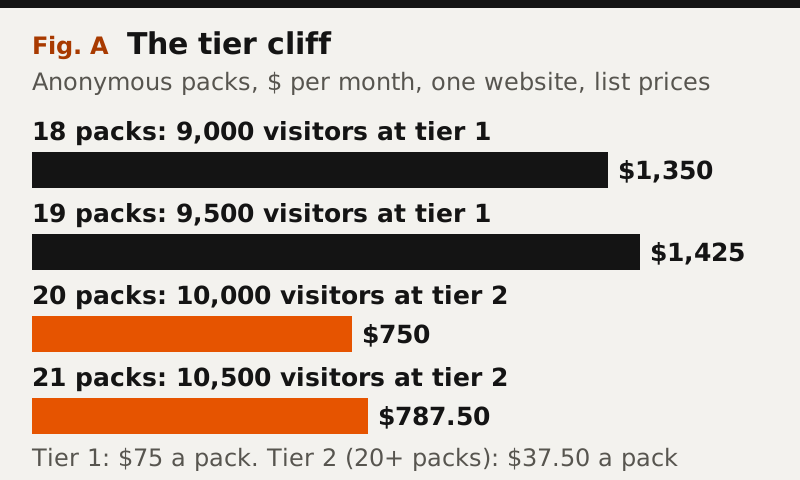
The same logic applies to authenticated packs at a much larger scale: 99 packs at $200 cost $19,800 a month, while 100 packs at $75 cost $7,500. Few organizations sit near that line, but those that do should check it before renewing.
Pay-as-you-go: $4 and $0.30 per active user, and what isn't counted
Pay-as-you-go suits pilots, seasonal sites and sites whose traffic is hard to predict, because you pay only for users who show up. Microsoft Learn lists what the anonymous meter ignores: bots and crawlers; pages that return a redirect or any 4xx or 5xx error; sign-in, registration and similar authentication pages; system paths beginning with /_; requests for static files only; and sites in trial or private mode. A visitor who browses anonymously and then logs in on the same UTC day counts only as authenticated.
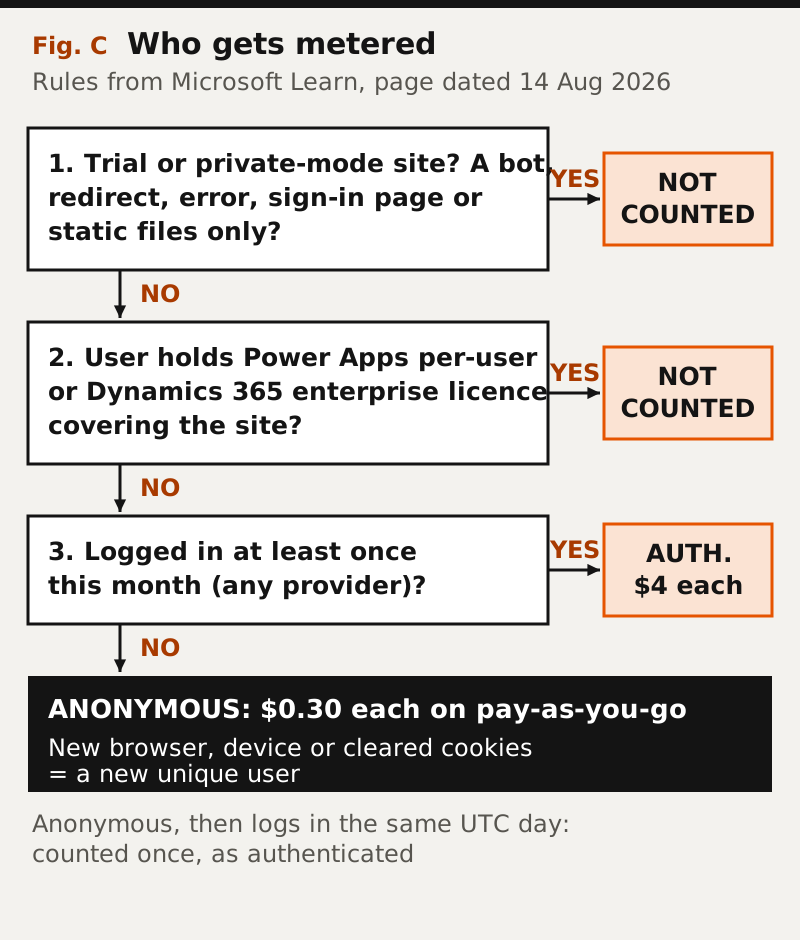
One operational tip is buried in that page: an uptime monitor that sends a normal browser user agent can be counted as an anonymous user. Microsoft recommends pointing monitors at the site's /_services/about page so they are not.
Licenses you may already have: Power Apps Premium, Dynamics 365, Microsoft 365 (none)
The licensing guide's use-rights table answers the most common question directly: Microsoft 365 and Office 365 include no Power Pages rights. Power Apps Premium includes unlimited Power Apps and Power Pages websites for the licensed user, and Dynamics 365 Enterprise and Premium apps cover sites mapped to the same environment. On the meters, Microsoft Learn confirms that users with a Power Apps per-user license, or a Dynamics 365 enterprise license that gives access to the website, are not counted.
| License | Power Pages use rights |
|---|---|
| Microsoft 365 / Office 365 | None |
| Power Apps Premium | Unlimited Power Apps and Power Pages websites for the licensed user |
| Dynamics 365 Enterprise and Premium apps | Websites mapped to the same environment |
| Everyone else (customers, partners, the public) | Covered only by capacity packs or pay-as-you-go |
In practice that means a company's own staff, if they already hold Power Apps Premium or a Dynamics 365 enterprise license, can use its portals without extra Power Pages capacity, while external users always need packs or the meter.
Trial, private mode and the "vTrial for Makers" question
Microsoft's Power Pages trial FAQ on Microsoft Learn, read on 10 October 2026, says a Power Pages site "is always created as a trial". The trial environment lasts 30 days and can be extended once by another 30; a trial site created in a non-expiring environment lasts 90 days. When a trial site expires it is suspended, and seven days later it is deleted, unless it has been converted to production with the required licenses. Trial and private-mode sites are not counted by the pay-as-you-go meters.
Searches for "Power Pages vTrial for Makers" reach this page often. That phrase does not appear in Microsoft's trial FAQ or its licensing pages that we read, so we will not guess at its terms; check the license's details in the Microsoft 365 admin center, where the tenant's assigned licenses are listed.
A worked example: the 5,000-visitor brochure site
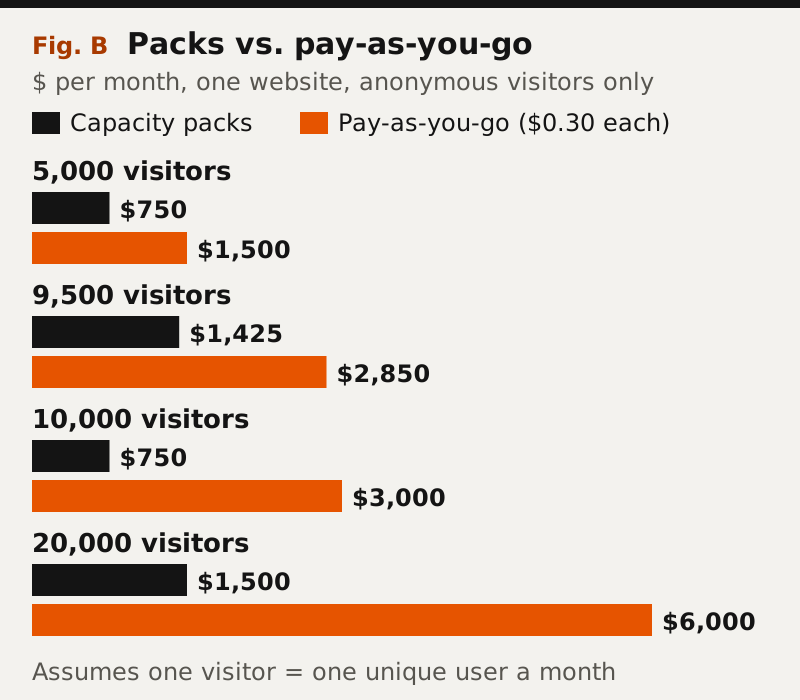
Take an ordinary small-business site: a public page, no logins, 5,000 unique visitors a month. On capacity packs, 5,000 anonymous visitors require ten of the 500-user packs, and ten times $75 is $750 per month, at list, paid yearly. On pay-as-you-go, 5,000 visitors times $0.30 is $1,500 per month. For a brochure site. Every other product on our register would host it for somewhere between $0 and $49 a month.
5,000 anonymous visitors a month ÷ 500 per pack = 10 packs; 10 × $75 = $750 a month, at list.
The other volumes follow the same rules. At 500 visitors, one pack costs $75 and the meter $150. At 9,500 visitors, 19 tier-one packs cost $1,425 and the meter $2,850. At the tier-one price, 10,000 visitors lifts the invoice to $1,500 a month on packs, but twenty packs is exactly the tier-two minimum, where the guide's table prices the same capacity at $750; the meter would charge $3,000. At 20,000 visitors, 40 tier-two packs cost $1,500 and the meter $6,000. At 50,000 visitors, 100 tier-two packs cost $3,750 against $15,000 on the meter.
Capacity is licensed per website, so a second site needs its own packs, and the meter counts a person once per website they visit. Before any of this, provisioning needs a Power Platform environment and someone comfortable administering Dataverse.
Who Power Pages is actually for
If your organization already runs on Dynamics 365, Dataverse and Entra ID, with an admin team that speaks Power Platform, and you need external users to touch internal data safely, Power Pages is a defensible choice. A city taking permit applications, an insurer with a claims portal, a manufacturer onboarding dealers: in those settings authenticated users are a cost worth governing, and the alternative is custom development. Judged as that product, it holds up well.
What a small business should use instead
If you arrived wanting an ordinary website, use almost anything else; we keep the ranked field on our big-tech website builders register. Inside this genre, Google Sites is free for informational pages and Square Online is free for selling, and our Google Sites review and Square Online review document both ceilings.
Beyond the genre, a conventional builder delivers a normal website on your own domain at a flat price that does not change with traffic: Squarespace, Wix or Hostinger for a tighter budget. Our guide to when you've outgrown them covers that move, and the hidden limits of free big-tech builders is the companion read on fine print.
Frequently asked questions
Q.01Is Power Pages included in Office 365 or Microsoft 365?
No. Microsoft's Power Platform Licensing Guide (October 2026) lists Microsoft 365 and Office 365 as carrying no Power Pages use rights. Internal users need Power Apps Premium or a qualifying Dynamics 365 license, and external visitors need capacity packs or pay-as-you-go.
Q.02How is Power Pages licensed?
Per website, per month, by unique visitors. You either prepay capacity packs, $200 per 100 authenticated users or $75 per 500 anonymous users at list, billed yearly, or use pay-as-you-go at $4 per active authenticated user and $0.30 per active anonymous user (prices read 9 Oct 2026).
Q.03What is the Power Pages anonymous users license?
It is the anonymous capacity pack: 500 unique non-signed-in visitors per website per month for $75 at tier one, falling to $37.50 a pack from 20 packs and $25 from 200 packs in the October 2026 licensing guide. Anonymous visitors are counted by a browser cookie, so a new device or cleared cookies counts as a new user.
Q.04Are Power Pages capacity packs per site?
Yes. Packs are bought for a specific website and month, a second website needs its own capacity, and unused capacity does not carry over to the next month.
Q.05Is there a free version of Power Pages?
There is a free 30-day trial, extendable once, and trial and private-mode sites are not metered. There is no free production tier: a public site needs at least one $75 anonymous pack or the pay-as-you-go meter.
Position in the field: the big-tech website builders register. Outgrowing these products entirely is covered in when you’ve outgrown them.